
Former Research Projects
- Joint Research and Compilation Project on "Multilingual Version of Pictopedia of Everyday Life in Medieval Japan"
-
Joint Research and Compilation Project on "Multilingual Version of Pictopedia of Everyday Life in Medieval Japan"
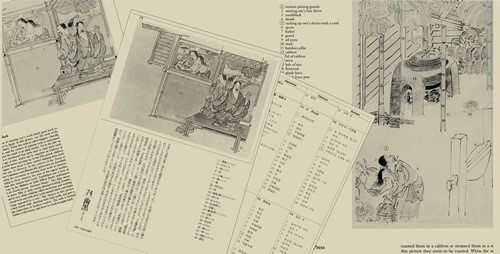
Multilingual Version of Pictopedia of Everyday Life in Medieval Japan Aim of the joint research project
Of the five volumes of “Multilingual Version of Pictopedia of Everyday Life in Medieval Japan", the first and second volumes were published in our project selected in the 21st Century COE Program,and the third volume was published in the first term joint research project of the Center. Subsequently, the main text of the fourth volume was published in the term four. This research project is aimed at translating and publishing complete translation of whole 5 volumes. We hope that researchers in history, folklore,anthropology,literature and other fields of study will use these 5 volumes of publications to learn about “everyday life" in medieval Japan.
Period 2023-2025(3 years)
Members
Research leader BOCCELLARI John Researchers NAKABAYASHI Kazuhiro - Media, Body, and Gender in Turn of the Century Europe
-
Media, Body, and Gender in Turn of the Century Europe
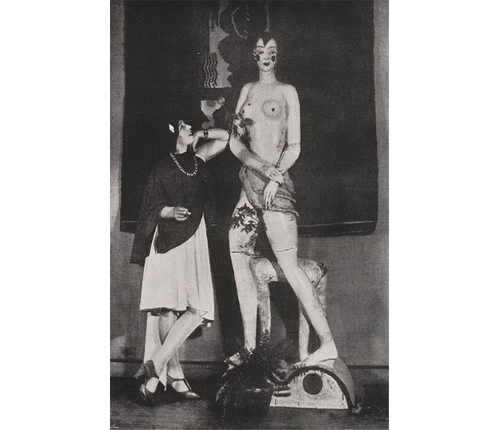
Vally Wieselthier, Wiener Werkstätte’s Designer
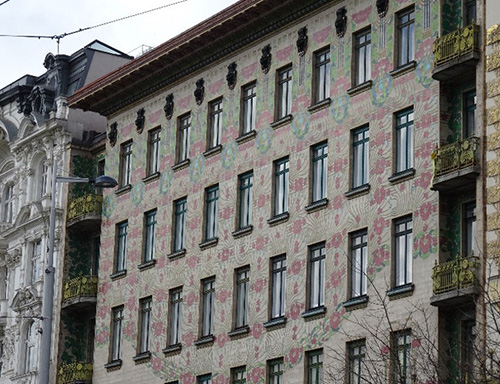
Majolica House(Otto Wagner) Aim of the joint research project
In the course of our research into popular culture in Term 5, we found that in order to explore physical representation in the early 20th century, it is necessary to look at not only iconographic sources such as pictures and photographs, and materials centering on physical techniques that appeared in theater, dance, and films, but also more diverse forms of media including design, posters, and fashion. From 2023 onward, our study will thus aim to elucidate cultural phenomena that show a correlation between various forms of media (e.g., literary cabarets like Le Chat Noir) from their relationship with written and nonwritten materials, with a focus on the turn of the century. Because these cultural phenomena are situated on the periphery of or beyond existing research fields, sufficient research has not been carried out before. This study will examine these phenomena around the themes of physical expression and gender, and by covering not only Germany and France but also Austria, which is closely related to both of these countries, we hope to shed light on the dynamic current of culture and art at the turn of the century.
Period 2023-2025(3 years)
Members
Research leader KUMAGAI Kensuke Researchers BUCHENBERGER Stefan, KAKUYAMA Tomoko Visiting researchers KOMATSUBARA Yuri, TANAKA Rina - Research on the Development of Cities and Architecture in the Open Ports (International Settlements and Foreign Concessions) of East Asia
-
Research on the Development of Cities and Architecture in the Open Ports (International Settlements and Foreign Concessions) of East Asia
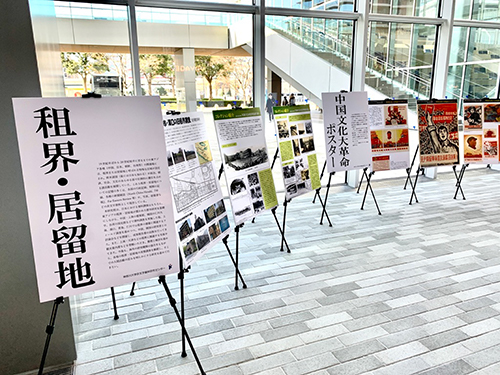
Exhibition of display panels introducing the activities of the group 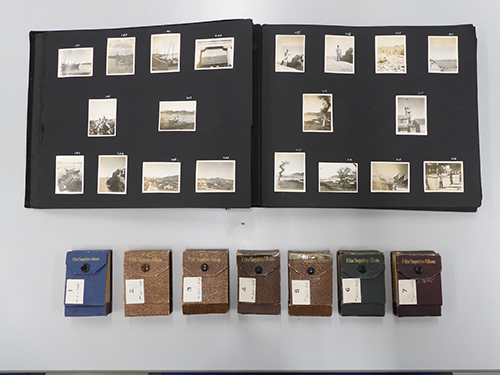
Collection of photographs of Shanghai taken by Kawai Yasuhei Aim of the joint research project
Our previous research on Japanese activities in the open ports (international settlements and foreign concessions) of East Asia focused on selected Japanese communities located mainly in Shanghai. From FY2023 onward, we will additionally include Qingdao and Guangzhou in our study in order to compare North, Central, and South China in terms of the development of cities and architecture in the international settlements.
Notably, we will conduct research activities with assistance from the Ocean University of China in Qingdao and Guangdong University of Foreign Studies in Guangzhou. Our study continues to use the resources uncovered in the previous terms of this project, including materials from the Diplomatic Archives of the Ministry of Foreign Affairs of Japan, Shanghai Municipal Archives, and Academia Sinica of Taiwan, newspapers (North China Herald and Shen Bao), magazines (Far Eastern Review, Shina Jihen Gaho, and Shashin Shuho), postcards from the Tsunehiro Kondo Collection at the Research Center for Nonwritten Cultural Materials, Kanagawa University, and photograph books. In addition, we are making ongoing efforts to utilize the photographs of Shanghai from the collection of the late Kawai Yasuhei , donated in 2022, and organize the serial publication of “Posters of the Chinese Cultural Revolution” (scheduled for February 2024).Period 2023-2025(3 years)
Members
Research leader SON An Suk Researchers UCHIDA Seizo, MURAI Hiroshi, PENG Guoyue, SUZAKI Fumiyo, KANG Myungchae Visiting researchers KIKUCHI Toshio, OSATO Hiroaki Research collaborators TOMII Masanori, TAJIMA Natsuko, BAO Muping, KITAHARA Itoko, GUO Mengyao - Places of Worship in Modern Japan and Overseas Japanese Shrines
-
Places of Worship in Modern Japan and Overseas Japanese Shrines
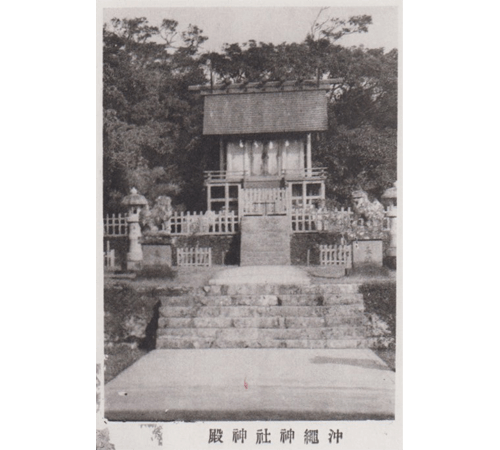
Sanctuary of Okinawa Shrine 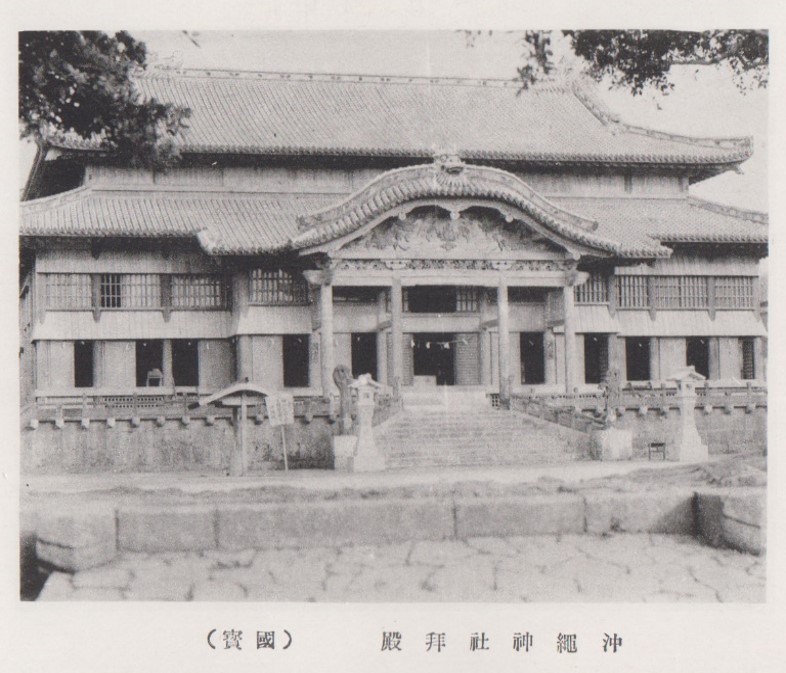
National Treasure: Worship Hall of Okinawa Shrine Aim of the joint research project
This joint research will study the environments and sceneries of shrines in modern Japan, sacred places such as utaki in Okinawa, and overseas Japanese shrines with the aim of casting light on religion and religious services in Japan, places of worship and their reorganization, and relationships with surrounding regions. Building on the findings of research into overseas Japanese shrines carried out under the 21st Century COE Program, the project this term will revolve around the theme of Shuri Castle as a place of worship and its reorganization (at one time, the site was designated as Okinawa Shrine). With buildings including Seiden, or the main hall, undergoing reconstruction following the fire in 2019, we will approach Shuri Castle as modern example of spatial reorganization. Beyond Okinawa Shrine and Shuri Castle, we hope to develop a pool of examples with an eye to places of worship in other regions as well, from an interest in the border areas of Japan and overseas Japanese shrines. While working primarily with nonwritten cultural materials, in an effort to collect and organize basic reference materials, we will also make use of fieldwork as well as photographs and iconographic resources, with the hope of conducting a three-dimensional, multilayered analysis of written and unwritten materials. Finally, we will continue to revise the database of overseas Japanese shrines.
Period 2023-2025(3 years)
Members
Research leader SHIITADA Atsushi Researchers SUNAMI Soichiro,MARUYAMA Yasuaki,
DOYO Daisuke, SUNAMOTO FumihikoVisiting researchers SAKAI Hisanori, TSUDA Yoshiki, NAKAJIMA Michio,
MAEDA Takakazu,SUGA Koji, KAJI Yorihito,
KATO Saori,SAGAI Tatsuru, OGUMA MakotoResearch collaborators INAMIYA Yasuto, MATSUYAMA Hiroaki, IRAHA Kenya,
Louis CANALES - Research on Japan’s Wartime Propaganda Kamishibai and Mass Media
-
Research on Japan’s Wartime Propaganda Kamishibai and Mass Media
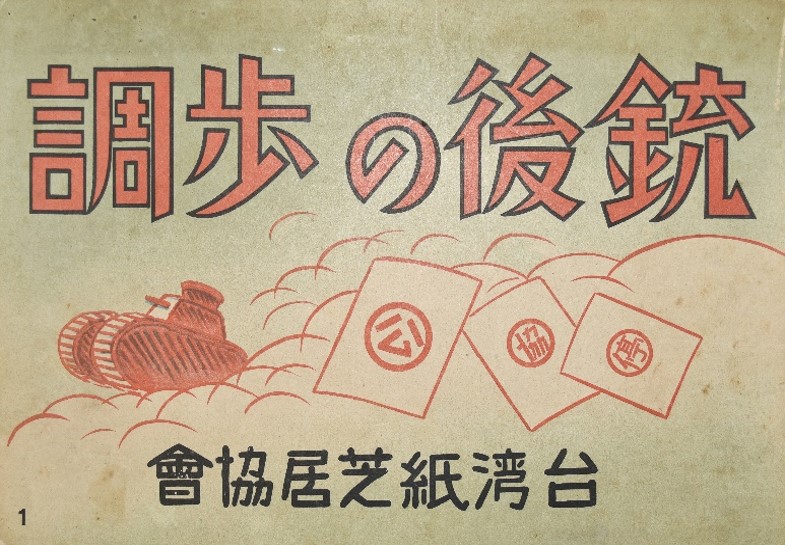
“Jūgo no Hochō/Tshing-āu-ê-Kioh-pōo” Taiwan Kamishibai Kyōkai(Collection of Mr.Liang Zhi Zhong) 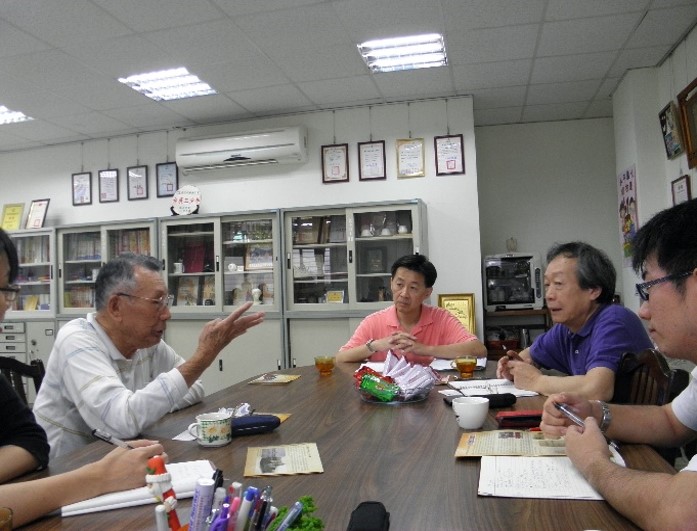
An interview with a member of the “Japanese Generation” in Taiwan Aim of the joint research project
This research project has continued for nine years since it was launched in FY2014. During this time, we published the independent book “Japan’s Fifteen-Year War Seen from Propaganda Kamishibai” (Bensei Publishing, Inc., March 2018; hereinafter “Kokusaku”) and booklet “Japan’s Wartime Propaganda Kamishibai: Local Points of View and the Experience of Colonial Rule” (Ochanomizu Shobo, March 2022); and shared our findings from local surveys of about 30 locations including those abroad (Taiwan) and contributed an ongoing series of research reports on kamishibai works (terminology and characters) in each issue of the Research Center for Nonwritten Cultural Materials News Letter, including an extra issue. “Kokusaku” consisted of a bibliographical introduction of 240 kamishibai from the Tomio Sakuramoto collection. Local surveys conducted later, however, revealed some 270 more works, and a project is underway to compile them in a “Kokusaku” sequel. In addition to introducing the newly found works, the sequel is scheduled to include articles by several researchers and revised national bibliographic data. From FY2023 onward, we hope to base our activities on constant investigation and research, while publishing the sequel as well as collaborating with the National Museum of Taiwan History, with which we concluded a research exchange agreement in FY2022, to carry out even deeper research into kamishibai under Japanese colonial rule. We plan to share our research findings in two or three symposiums.
Period 2023-2025(3 years)
Members
Research leader ARAKAKI Yumeno Visiting researchers OGUSHI Junji, MORIYAMA Atsushi Research collaborators KOYAMA Ryo, HARADA Hiroshi,SUZUKI Kazufumi,
MATSUMOTO Kazuki, TOMIZAWA Tatsuzo, QIU Yuxiang - Research on Sea and Port Canals—Canals in Yokohama and Asia
-
Research on Sea and Port Canals—Canals in Yokohama and Asia
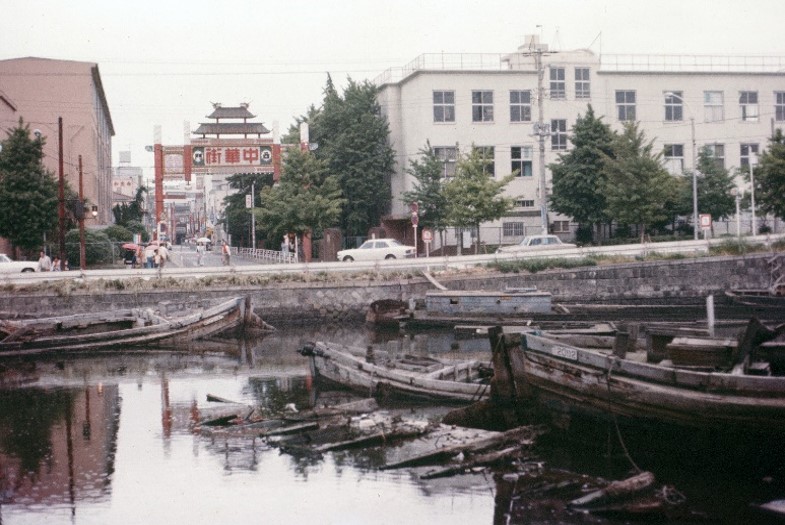
The West Gate of Chinatown and the Haooka River before Reclamation 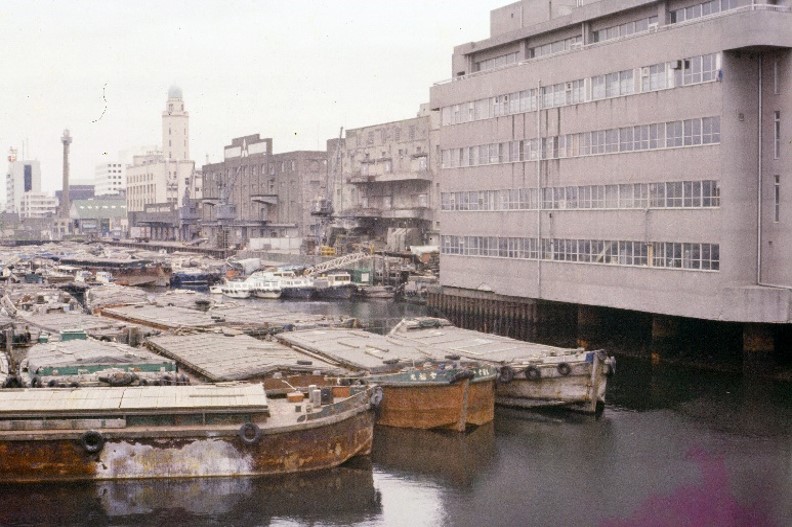
Looking toward Marine Tower and Queen's Tower from Bankoku Bridge Aim of the joint research project
This joint research project aims to investigate the rapid changes in Yokohama’s seaside and canals from the Edo period (1603–1868) to the Meiji period (1868–1912) and throughout the Showa period (1926–89) from the viewpoints of history, architecture, and human geography. Specifically, it will:
- Examine the changes in Yokohama’s waterfront and canals through photographs of the coastal area of Yokohama in the 1970s recorded by the Mikio Takagi Lab, in the Department of Architecture at Kanagawa University, and study the changes in canals, architecture, fishing, longshoring, and the living environment in relation to changes in the environment and scenery.
- Observe the depictions of Yokohama’s canals in Yokohama-e woodblock prints produced between the late Edo period and the early Meiji period, and compare them with photographs of Yokohama’s canals in the prewar period.
- Draw a comparison between the changes in Yokohama’s canals and other regions such as the Jiangnan area of China (Shanghai), the Korean Peninsula (Seoul and Busan), and Taiwan (Taipei).The project also seeks to explore the influence of the seaside and canals on lifestyle, industry, and the environment in Yokohama, Shanghai, Seoul, and other large Asian cities that developed amid great waves of modernization based on illustrated materials.
Period 2023-2025(3 years)
Members
Research leader UCHIDA Seizo Researchers SON An Suk, YAMAGUCHI Taro, NAKABAYASHI Hirokazu,
KANG MyungchaeResearch collaborators MATSUMOTO Kazuki, KANAMARU Hisao - Basic Research on Voice and Body in Artistic Expression—Performing Art, Classical Entertainment, and Contemporary Art
-
Basic Research on Voice and Body in Artistic Expression—Performing Art, Classical Entertainment, and Contemporary Art
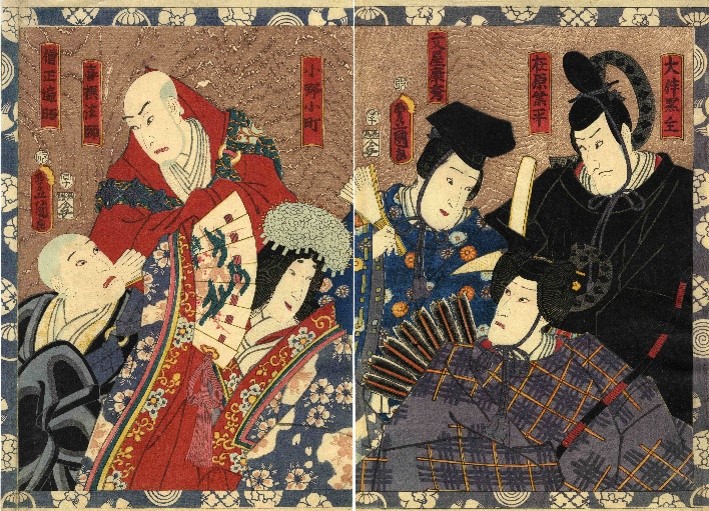
"Rokkasen" painted by Toyokuni Utagawa III 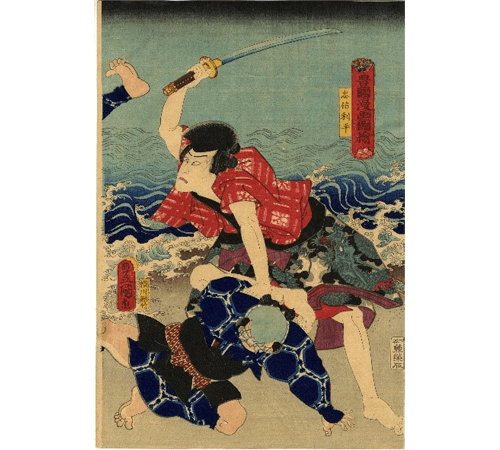
"Toyokuni Manga Zue, Tadanobu Rihei" painted by Toyokuni III Aim of the joint research project
This research project is a developmental extension of the FY2022 Preparatory Joint Research Project C themed Basic Research on Voice and Body in Artistic Expression—Performing Art, Classical Entertainment, and Contemporary Art. In FY2022, we invited performers and organized presentations ranging from contemporary theater to the Satsuma biwa lute, and obtained a great amount of knowledge from those activities. Moving forward, we will share this knowledge among the team, including our new members, and by exchanging our awareness of issues and working across our fields of specialty, continue to carry out diversified research activities, setting our sights on the physical techniques of performances including kabuki, modern theater, butoh dance, rakugo storytelling, films, and contemporary art, while shining the spotlight on the voice and body.
In addition to live performances, this project seeks to also look into recordings on paper and video media in order to investigate, analyze, and explore the various forms of voice and body expression and reception amid the historical and genre-related limits and possibilities of modern Japan.Period 2023-2025(3 years)
Members
Research leader MATSUMOTO Katsuya Researchers FUJISAWA Akane, MIZUKAWA Hirofumi Visiting researchers GOTO Ryuki - Reconsidering Nonwritten Cultural Materials: Possibilities and Issues Regarding Nonwritten Cultural Materials
-
Reconsidering Nonwritten Cultural Materials: Possibilities and Issues Regarding Nonwritten Cultural Materials
Aim of the joint research project
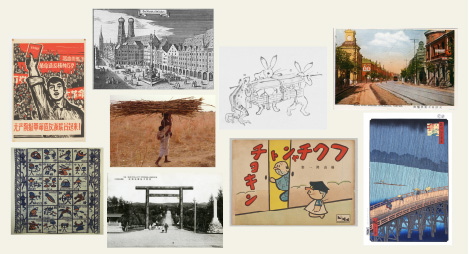
This research group will focus on Nonwritten Cultural Materials themselves and define the purpose on sharing perspectives to view them. Although the Center has been active for 20 years, it has yet to reach a definitive understanding of Nonwritten Cultural Materials. One of the reasons for this is the nature of Nonwritten Cultural Materials themselves, which makes it difficult to define the scope and methods of research. It is also necessary to focus on the gaps in understanding that exist among individual researchers toward Nonwritten Cultural Materials.
In view of the current situation, this research group would like to reexamine what Nonwritten Cultural Materials are and provide an opportunity to compare the understanding among participants through discussion. It is hoped that this work will lead to a more refined understanding of Nonwritten Cultural Materials, and that it will also advance research into areas that have not been explored in the past.
The research group will carry out its activities with the above objectives in mind, and in addition to discussions among researchers at study workshops, will actively plan and organize lecture meetings. By holding lectures on a variety of themes and topics, it is expected that participants will engage in fruitful discussions and share and deepen their knowledge of Nonwritten Cultural Materials.Period 2024-2025(two years)
Members
Research leader NAKABAYASHI Hirokazu Researchers KUMAGAI Kensuke, SHIITADA Atsushi
Joint Research Projects; TERM5 (FY2020-FY2022)
- Joint Research and Compilation Project on "Multilingual Version of Pictopedia of Everyday Life in Medieval Japan"
- Research on People’s Lives and Customs in Early Modern and Modern China
- 20th-Century European Popular Culture as Seen through the Media and the Body
- Research on the Development of Cities and Architecture in the Open Ports (International Settlements and Foreign Concessions) of East Asia
- The Reorganization of Religious Services and the Establishment of Japanese Shrines in the Border Areas of Imperial Japan
- Research on Basic Technologies that Apply Machine Learning and Block Chain Designed to Address the Challenges of Distributing Nonwritten Cultural Materials
- Research on Wartime Japan’s Propaganda Kamishibai
Joint Research Projects ; TERM4(FY2017-FY2019)
- Joint Research and Compilation Project on "Multilingual Version of Pictopedia of Everyday Life in Medieval Japan"
- City Life in 19th Century Europe as Seen in Paintings, Prints and Photographs
- Groundwork for the Second Phase Compilation of the “Pictopedia of Everyday Life in East Asia(Compiled on South of the Yangzi River, China)”
- Joint Research and Compilation Project on “Pictopedia of Everyday life in Early Modern Japan Focusing on the Ryukyuan Embassy Processions in the city of Edo”
- Various Activities and Industries of the Japanese People at Open Ports (International Settlements and Foreign Concessions) in East Asia
- The Reorganization of Religious Services and Shrines in Modern Okinawa
- An Experiment in Medieval Landscape Restoration- Somuta Village in Wakamatsu-Ku, Kitakyushu City as a Case Study
- Research on Efficient Searching and Safe and Secure Distribution of Information and Services in the Nonwritten Cultural Materials Research Community
- Research on Popular Media in Wartime Japan(1937-45)
Joint Research Projects ; TERM3(FY2014-FY2016)
- Joint Research and Compilation Project on "Multilingual Version of Pictopedia of Everyday Life in Medieval Japan"
- Research Project on Pictopedias of Everyday Life in Europe during the First Half of the 19th Century
- Former Japanese Concessions in China and Korea
- Follow-up Research on the Historical Sites of Overseas Japanese Shrines
- Environmental History of Life in Brackish Water Areas
- Research on How Houseboat People Lived and How Their Lives Changed
- Research on Basic Technologies, Including Data Mining and a User Interface, for the Internet Eco-Museum
- Research on Popular Media in Wartime Japan
Joint Research Projects ; TERM2(FY2011-FY2013)
- Joint Research and Compilation Project on Pictopedias of Everyday Life
- 1A. Joint Research and Compilation Project on Multilingual Version of Pictopedia of Everyday Life in Medieval Japan
- 1B. Joint Research and Compilation Project on Pictopedias of Everyday Life in Early Modern Japan Focusing on Amami and Okinawa
- 1C. Joint Research and Compilation Project on Pictopedias of Everyday Life in Modern Europe
- Joint Research on Concessions and Media Space in East Asia
- Joint Research on Continuity and Transformation of Scenery as Seen from Japanese Shrines Site
- Joint Research on Environmental History of Waterfront Life
- Joint Research on Effective Retrieval and Secure Distribution of Nonwritten Cultural Materials
Joint Research Projects ; TERM1(FY2008-FY2010)
A Core Joint Research Projects
As an organization that inherits the 21st Century COE Program and aspires to be a global training and research center, the Center shall build and preserve research networks, while researching and developing information dissemination systems.
- It will investigate, gather information and research on methods related to the formation of a global research network (hereafter referred to as“Studies on Network Formation for Research on Nonwritten Cultural Materials”)
- It will promote studies on system development related to the collection, organization, preservation, and disclosure / dissemination of nonwritten cultural materials (hereafter referred to as “Studies on System Development for the Dissemination of Nonwritten Cultural Materials”)
B Specific Joint Research Projects
Based on the accumulated research know-how from the 21st Century COE Program, the Center shall set new research issues and conduct joint research projects.
- Compilation and Joint Research on the Multilingual Version of Pictopedia of Everyday Life in Medieval Japan
- The Process of Urban Reconstruction Following the Great Kanto Earthquake, Creation of Database and Collection of Materials
- Former Japanese Concessions in China and Korea
- Studies on the Realities of Continuity and Transformation - the Case of 60 Years of Study in Tsushima